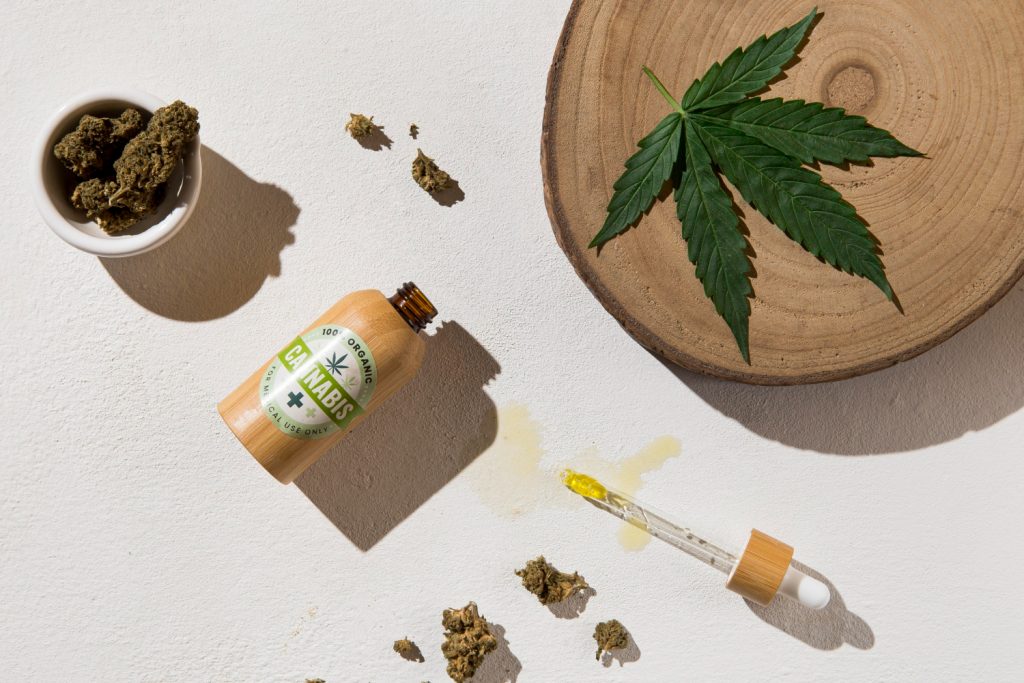
What’s inside a CBD oil bottle — ingredients breakdown
A bottle of cannabidiol (CBD) oil contains two primary components: a hemp extract and a carrier oil. That’s it for a well-made product. The hemp extract supplies cannabinoids — CBD as the primary compound, plus minor cannabinoids like cannabigerol (CBG), cannabinol (CBN) and CBC depending on the spectrum type. The carrier oil suspends the extract in a form the body can absorb. Everything else on the label — concentration, spectrum, extraction method — describes how those two components were produced and combined.
Some products add a third layer: flavourings, terpene blends or other additives. These are formulation choices, not requirements. The simplest CBD oils contain nothing beyond extract and carrier. This article breaks down each component, explains what the numbers on the label mean, and covers how to tell a well-formulated product from a poorly made one. For context on how that extract gets into the bottle, the CO₂ extraction process article covers the manufacturing side.
The hemp extract — cannabinoids and terpenes
The hemp extract is the active portion of CBD oil. Produced through CO₂ extraction or solvent-based methods, the extract contains the cannabinoids and terpenes that define the product. What ends up in the extract depends on the extraction method and any post-processing steps applied afterwards.
Full spectrum CBD oil retains the complete chemical profile from the hemp plant: CBD as the dominant cannabinoid, plus CBG, CBN, CBC, CBDV, trace tetrahydrocannabinol (THC) below 0.3%, terpenes (myrcene, limonene, beta-caryophyllene and others) and flavonoids. Nothing selectively removed after extraction.
Broad spectrum CBD oil goes through an additional chromatographic step to remove THC below detectable limits while preserving the remaining cannabinoids and terpenes. The cannabinoid profile is nearly identical to full spectrum minus the THC line on the certificate of analysis (COA).
CBD isolate is pure cannabidiol at 99%+ purity — every other compound stripped away during processing. No minor cannabinoids, no terpenes, no THC. The simplest and most refined form.
For a side-by-side comparison of all three types, see the full spectrum vs broad spectrum breakdown. The choice between them affects what’s in the bottle at the molecular level.
The carrier oil — why it’s there and what’s used
Cannabinoids are fat-soluble. They dissolve in oils and fats, not in water. Without a carrier oil, the hemp extract would be a thick, concentrated paste — difficult to dose, hard to absorb and impractical to dispense from a dropper bottle. The carrier oil dilutes the extract to a usable concentration and provides a fat matrix that improves cannabinoid absorption.
MCT coconut oil is the most common carrier in CBD products. Medium-chain triglyceride oil, derived from coconut, is flavourless, odourless and absorbs quickly. MCT oil consists of medium-length fatty acid chains (C8 and C10) that the body processes efficiently. EU Labs uses MCT coconut oil across the entire product range — CBD, CBG, CBN and pet oils. For the distinction between hemp seed oil and CBD oil as products, see hemp oil vs CBD oil.
Hemp seed oil is another carrier option. Pressed from hemp seeds — not the flowers, leaves or stalks where cannabinoids concentrate — hemp seed oil contains omega-3 and omega-6 fatty acids but no significant cannabinoid content on its own. Some brands use hemp seed oil as a carrier to keep the entire product hemp-derived. The trade-off: hemp seed oil has a nuttier taste and a slightly different absorption profile compared to MCT.
Olive oil appears in some European CBD formulations. It works as a carrier but has a distinct flavour, higher viscosity and slower absorption than MCT. Less common in the Australian market.
Concentration — what the numbers mean
Every CBD oil label shows a total milligram figure — 1500mg, 3000mg, 12000mg. That number represents the total amount of cannabidiol dissolved in the entire bottle, not per drop or per serving. The number that actually matters for dosing is the concentration per millilitre (mg/mL), which depends on the bottle size.
EU Labs CBD Oil 3000mg comes in a 50 mL bottle. Divide 3000 by 50 and the concentration is 60 mg of CBD per millilitre. The EU Labs CBD Oil 3000mg Full Spectrum and the broad spectrum version deliver identical concentrations — 60 mg/mL — in the same bottle size. The only difference between the two is the presence or absence of trace THC.
At a higher concentration, the EU Labs CBD Oil 12000mg delivers 240 mg/mL from the same 50 mL bottle. Four times the cannabidiol per drop. Same carrier oil, same extraction, same bottle — more extract per millilitre. The CBD oil concentrations article explains the maths in detail, and the 3000mg vs 12000mg comparison covers when each concentration makes practical sense.
A standard glass dropper dispenses approximately 20 drops per millilitre. At 60 mg/mL, each drop delivers roughly 3 mg of CBD. At 240 mg/mL, each drop delivers roughly 12 mg. The CBD oil dropper guide covers how to measure consistent servings.
What shouldn’t be inside a CBD oil bottle
A well-made CBD oil contains hemp extract and carrier oil. Anything beyond those two ingredients is an addition — sometimes benign, sometimes not. Knowing what to look for on an ingredient list separates a transparent product from a questionable one.
Artificial flavourings and sweeteners. Some brands add flavourings to mask the natural hemp taste. Flavouring itself isn’t inherently problematic, but artificial sweeteners like xylitol (toxic to dogs, sometimes found in human wellness products) and synthetic flavour compounds add ingredients with no functional purpose. EU Labs CBD oils contain no added flavourings — just hemp extract and MCT coconut oil.
Unnecessary additives. Preservatives, emulsifiers, colouring agents and thickeners sometimes appear in lower-quality products. None of these are required for a CBD oil to function. A short, clean ingredient list — hemp extract and carrier oil — is a positive sign.
Unlisted ingredients. If the COA shows compounds not mentioned on the label, something is wrong. The certificate of analysis should match what the ingredient list claims. A COA that shows unexpected cannabinoids, elevated THC or contaminant levels contradicts the product label — and contradicting labels mean either mislabelling or manufacturing error. The third-party lab testing article explains how to read a COA properly.
How to verify what’s actually inside
The ingredient list tells you what should be inside. The COA tells you what is. Both should match. Checking takes two steps.
First, read the ingredient list on the product label or product page. A CBD oil should list: hemp extract (specifying spectrum type and cannabinoid), carrier oil (MCT, hemp seed or olive), and any additional ingredients. If the list is vague — “proprietary blend,” “natural ingredients” — the product lacks transparency.
Second, check the batch-specific COA. The cannabinoid panel confirms CBD concentration matches the label claim (within 10–15%). THC levels should match the spectrum type — trace amounts for full spectrum, “ND” for broad spectrum. Contaminant panels confirm the oil is free from heavy metals, pesticides, residual solvents and microbial contamination. Every EU Labs bottle links its batch number to an independent lab report covering all six testing panels.
The full EU Labs product range — CBD, CBG and CBN oils at various concentrations — is available in the Stillroot shop. For a walkthrough of the buying process, the what to look for when buying online guide covers verification steps in detail.
Frequently asked questions
What are the ingredients in CBD oil?
A standard CBD oil contains two ingredients: a hemp extract (providing cannabidiol and other cannabinoids depending on spectrum type) and a carrier oil (typically MCT coconut oil). Full spectrum CBD oil also contains trace THC below 0.3%, minor cannabinoids like CBG and CBN, terpenes and flavonoids. Broad spectrum removes the THC. Isolate contains only pure CBD and carrier oil.
Why is MCT coconut oil used as a carrier?
Cannabinoids are fat-soluble — they dissolve in oils, not water. MCT (medium-chain triglyceride) coconut oil is flavourless, absorbs quickly and provides an efficient fat matrix for cannabinoid delivery. EU Labs uses MCT coconut oil across the entire range, including CBD, CBG, CBN and pet CBD oils.
What does the milligram number on a CBD oil bottle mean?
The milligram number (e.g. 3000mg) represents the total cannabidiol content in the entire bottle — not per drop or per serving. To find concentration per millilitre, divide total milligrams by bottle volume. A 3000mg oil in a 50 mL bottle delivers 60 mg/mL. The concentrations explained article covers the full calculation.
Should CBD oil have a strong taste?
Full spectrum CBD oil has a mild to moderate earthy, herbaceous taste from the hemp extract and terpenes. Broad spectrum tastes similar but slightly milder. CBD isolate in MCT oil is nearly flavourless. A very bitter or chemical taste may indicate poor-quality extraction or additives not listed on the label.
How do I know if a CBD oil has unnecessary additives?
Read the ingredient list. A quality CBD oil lists hemp extract and carrier oil — possibly with a specified flavouring. If the list includes preservatives, emulsifiers, artificial sweeteners, colouring agents or vague terms like “proprietary blend,” those are additions beyond what a CBD oil requires. Cross-check the ingredient list against the certificate of analysis to confirm nothing unexpected appears in the lab results.
These products have not been evaluated by the TGA. They are not intended to diagnose, treat, cure, or prevent any disease. You must be 18+ to purchase. Please consult a healthcare professional before use.