CBD oil dosage for dogs — a practical guide
Giving a dog cannabidiol (CBD) oil raises an immediate practical question: how much? The answer isn’t a fixed number. Serving size for dogs is calculated from body weight, product concentration and a starting principle of beginning low and adjusting over time with veterinary guidance.
This guide covers how body weight drives the calculation, how to measure specific amounts from a glass dropper, what the EU Labs Pet CBD Oil 2000mg delivers per drop, administration methods and what to observe after starting. It does not replace veterinary advice. Any CBD oil routine for a dog should begin with a conversation with a veterinarian — the talking to your vet guide covers how to prepare for that appointment.
Why body weight is the starting reference
Body weight is the standard starting reference for CBD oil serving size in dogs because the relationship between animal size and appropriate amount is more consistent than other variables. A 5 kg Chihuahua and a 35 kg Labrador are not interchangeable — the same number of drops represents very different amounts per kilogram, and dogs across that weight range respond to cannabinoids differently.
The commonly cited starting framework in veterinary and pet cannabinoid literature is 1–2 mg of CBD per kilogram of body weight. This is a reference, not a prescription. It gives a vet something concrete to adjust from. The actual amount for any individual dog depends on breed, age, body composition, existing conditions, current medications and clinical judgement.
Dogs have a higher density of CB1 cannabinoid receptors in certain brain regions than humans, which means they respond to smaller amounts relative to body weight. This is also why THC sensitivity in dogs is significantly higher than in adult humans — relevant when choosing between full spectrum (trace THC present) and broad spectrum (THC removed below detectable limits). The full spectrum vs broad spectrum comparison explains the formulation difference. The pet CBD oil in Australia overview covers THC sensitivity in more detail.
The low-and-slow principle
Starting with the lowest practical amount and observing before adjusting is the standard approach for CBD oil in dogs. Most pet owners and vets working with CBD oil start at the lower end of the weight-based range — closer to 1 mg per kilogram than 2 mg — and hold that amount for one to two weeks before deciding whether to adjust.
The reasoning is practical. Individual dogs vary in how they respond to cannabinoids. Starting high bypasses the opportunity to identify the minimum appropriate amount for that specific animal. Starting low and adjusting upward, if the vet advises, produces clearer information about how the dog responds at each level.
This principle applies regardless of the dog’s size. A 30 kg German Shepherd and a 6 kg Maltese both benefit from starting conservative and adjusting methodically. The weight-based calculation gives the starting point; observation and veterinary guidance determine where to go from there.
Measuring drops from the EU Labs pet product
The EU Labs Pet CBD Oil 2000mg Full Spectrum delivers 40 mg of cannabidiol per millilitre in a 50 mL glass dropper bottle. The glass dropper delivers approximately 20 drops per millilitre, which means each drop contains roughly 2 mg of CBD.
Using 1 mg per kilogram as the starting reference:
- 5 kg dog — approximately 5 mg → 2–3 drops
- 10 kg dog — approximately 10 mg → 5 drops
- 15 kg dog — approximately 15 mg → 7–8 drops
- 20 kg dog — approximately 20 mg → 10 drops
- 30 kg dog — approximately 30 mg → 15 drops
- 40 kg dog — approximately 40 mg → 1 mL / full dropper
These are reference calculations — confirm the starting amount with a veterinarian who knows the dog. The concentrations explained article covers the mg/mL maths, and the pet vs human comparison explains why the 40 mg/mL pet formulation delivers a lower per-drop amount than the human range (60–240 mg/mL).
The glass dropper allows repeatable measurement. Fill it slowly by squeezing and releasing the rubber bulb while the tip sits below the oil surface. Count drops when giving small amounts to confirm consistency between servings. A partial squeeze delivers a partial dropper for amounts between whole millilitre marks.
How to give CBD oil to a dog
Three administration methods work in practice.
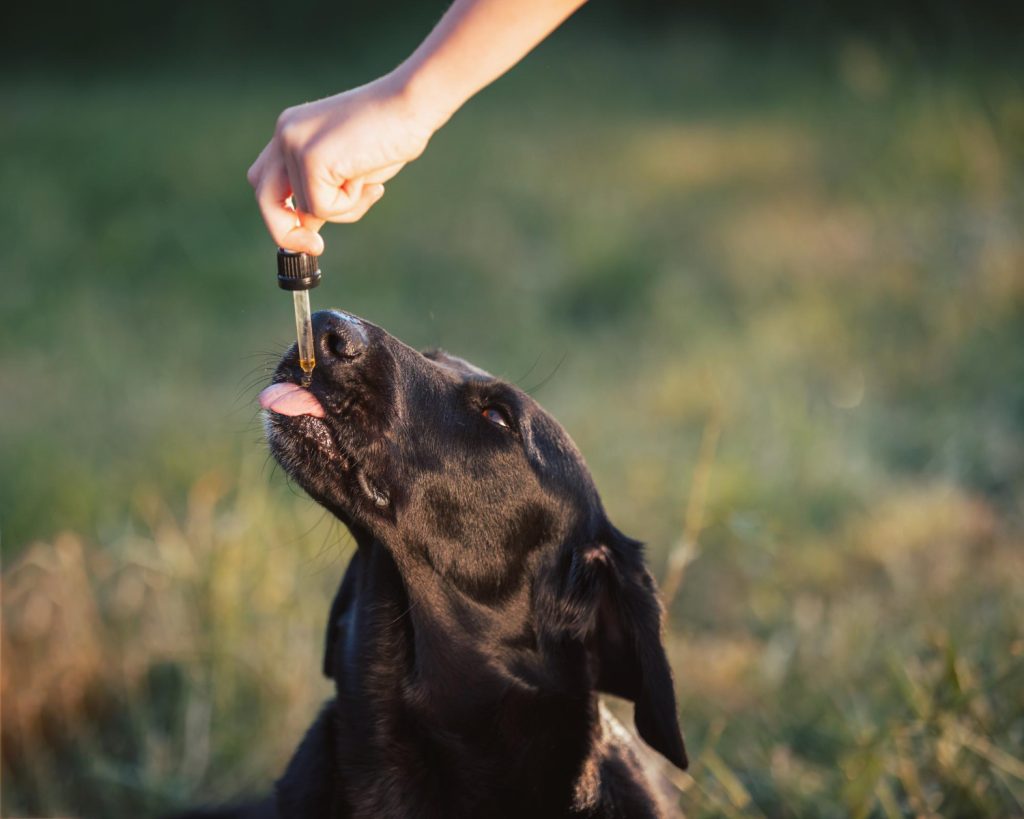
Directly into the mouth. Place the dropper tip into the side of the dog’s mouth and dispense onto the gum or cheek pouch. The oil absorbs through the mucous membrane — faster than digestion through the stomach. Some dogs accept this readily; others resist. Rewarding immediately afterward helps with compliance.
Applied to a treat. Drop the CBD oil onto a small piece of food — ideally something with fat content, since cannabidiol is fat-soluble and dietary fat assists absorption through the digestive system. This works well for dogs that won’t tolerate the dropper in their mouth. Onset is slower than direct oral delivery.
Mixed into a meal. Stir the oil into a small amount of food at the start of the meal. This confirms the dog ingests the full amount without leaving it at the bottom of the bowl. The meal’s fat content assists absorption, though onset via the digestive pathway typically ranges from 30 minutes to two hours.
Consistency matters more than method. Whichever approach works for the individual dog, use the same method at the same time each day. Varying method and timing from day to day makes it harder to observe how the dog is responding at a given amount.
What to observe after starting
Before starting, note the dog’s baseline — energy level, appetite, sleep pattern and any existing behaviours relevant to why CBD oil is being considered. A brief written log provides a reference point for comparison.
After starting at the initial amount, observe for seven to fourteen days before drawing conclusions. Factors to note: appetite, stool consistency, water intake, energy level, any changes in existing behaviours. Some dogs show no observable change at the starting amount; others respond more visibly.
If the dog shows signs of lethargy, loss of coordination, excessive drooling or vomiting, stop and contact a veterinarian. These signs can indicate THC sensitivity — particularly relevant if the product is full spectrum — or an adverse reaction to another ingredient. Every batch of EU Labs Pet CBD Oil includes a certificate of analysis covering cannabinoid potency, THC levels, heavy metals, pesticides, residual solvents and microbial contamination. The third-party lab testing article explains each panel, and the lab report guide walks through interpreting the results.
Bring the observation log to the follow-up vet appointment. A vet can assess whether the current amount is appropriate, adjust up or down, or recommend stopping based on documented observations.
Common mistakes with dog CBD dosing
Using a human product. Human CBD oil runs at 60–240 mg/mL. A single drop from the EU Labs CBD Oil 12000mg (240 mg/mL) delivers approximately 12 mg of cannabidiol — the same as six drops of the 40 mg/mL pet product. Accurately measuring fractions of a drop is not practical. Pet-specific products are formulated at a concentration that makes weight-based measuring manageable with a standard glass dropper.
Guessing without a weight-based calculation. “A few drops” is not a serving size. Start from body weight, apply the 1 mg per kilogram reference, and confirm with a vet. Guessing introduces unnecessary variability into an already individual process.
Changing amounts too frequently. Adjusting every two to three days doesn’t provide enough time to observe the dog’s response at any given level. Hold the initial amount for at least a week before considering a change, and confirm adjustments with a veterinarian.
Skipping the vet consultation. CBD can interact with medications metabolised through the cytochrome P450 enzyme pathway. A dog on NSAIDs, anticonvulsants or certain other medications may experience altered drug metabolism when CBD is added. A vet can identify these interactions; a pet owner generally cannot. The vet conversation guide covers what information to bring to the appointment.
Not verifying the COA. A pet CBD oil without a batch-specific certificate of analysis from an independent third-party laboratory has unconfirmed cannabinoid content and no documented contaminant screening. The label claim is unverified. EU Labs Pet CBD Oil includes a COA for every batch — batch number on the bottle matched directly to the lab report.
Full spectrum vs broad spectrum for dogs
EU Labs Pet CBD Oil 2000mg is a full spectrum product — the extract retains trace THC below 0.3% alongside CBD, minor cannabinoids and terpenes. For most dogs at weight-appropriate amounts, trace THC in a properly manufactured full spectrum pet oil is not expected to cause adverse effects. But dogs are more THC-sensitive than humans, and the calculation changes for small dogs at the higher end of a serving range.
Some pet owners and vets prefer broad spectrum CBD oil for dogs to remove THC exposure entirely. The broad spectrum option retains CBD and other cannabinoids but removes THC below detectable limits. Discuss spectrum choice with a veterinarian as part of the initial consultation — the right option depends on the individual dog, its weight and clinical assessment.
Where EU Labs pet CBD oil ships in Australia
The EU Labs Pet CBD Oil 2000mg Full Spectrum ships nationally from the Stillroot shop. Dog owners across Australia order from Sydney, Melbourne, Brisbane, Perth, Adelaide, Gold Coast, Canberra, Newcastle, Hobart and all other Australian locations.
Frequently asked questions
How much CBD oil should I give my dog per kilogram?
The standard starting reference is 1–2 mg of CBD per kilogram of body weight, with most vets recommending starting at the lower end before adjusting. EU Labs Pet CBD Oil 2000mg delivers approximately 2 mg per drop at 40 mg/mL, making weight-based calculation practical. Confirm the specific amount with a veterinarian before starting.
How many drops of CBD oil for a 10 kg dog?
Using EU Labs Pet CBD Oil 2000mg at 40 mg/mL (~2 mg per drop), a 10 kg dog starting at 1 mg per kilogram would receive approximately 5 drops. A 20 kg dog would receive approximately 10 drops. These are reference calculations — confirm with a vet who knows your dog’s specific situation.
Can I give my dog human CBD oil?
Human CBD oil is not recommended for dogs without veterinary guidance. The human EU Labs CBD range runs at 60–240 mg/mL — significantly higher than the 40 mg/mL pet product. Measuring small, weight-appropriate amounts from a high-concentration human product is not practical with a standard dropper. The pet-specific product is formulated for animal body weights. See the pet vs human comparison for the full breakdown.
Should I give my dog CBD oil with food?
CBD oil can be given directly into the mouth or applied to food. Giving CBD oil with fat-containing food may support absorption through the digestive pathway, since cannabinoids are fat-soluble. Direct oral delivery may produce faster onset. Either method works — consistency in approach matters more than which method you choose.
How long before I can assess the results in my dog?
Most vets recommend observing consistently for one to two weeks at the initial amount before assessing and adjusting. Keep a brief daily log noting appetite, energy level and any behavioural changes to bring to the follow-up veterinary consultation.
Do I need a vet prescription to buy pet CBD oil in Australia?
Pet CBD oil in Australia occupies a less clearly defined regulatory space than human CBD oil. The TGA regulates human CBD under Schedule 3 and 4; animal products fall under different legislation. The pet CBD in Australia article covers the regulatory context. Veterinary consultation is advisable regardless of the regulatory status.
These products have not been evaluated by the TGA. They are not intended to diagnose, treat, cure, or prevent any disease. You must be 18+ to purchase. Please consult a healthcare professional before use.