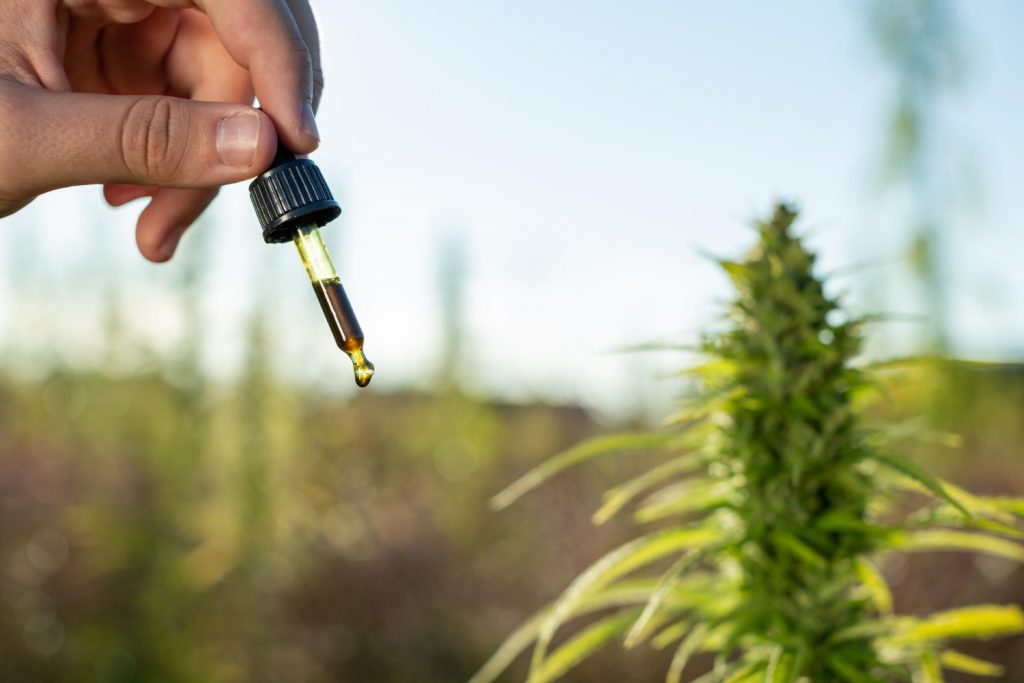
What the milligrams on a CBD oil label actually mean
Every CBD oil bottle has a milligram number on it — 1000mg, 3000mg, 6000mg, 12000mg. That number tells you the total amount of CBD dissolved in the entire bottle. It’s the single most important figure on the label, and it’s also the one most people misread.
A 3000 mg bottle doesn’t deliver 3000 mg per drop. It delivers 3000 mg across the full 50 mL of oil inside. To know what you get per millilitre, divide the total milligrams by the bottle volume. A 3000 mg bottle in 50 mL = 60 mg/mL. A 12000 mg bottle in 50 mL = 240 mg/mL. That per-millilitre figure is the number that actually matters when you’re measuring drops.
EU Labs prints both figures on the label — total milligrams and concentration per millilitre. Not all brands do. If you’re comparing products and one only lists the total milligrams without the bottle volume, do the maths yourself. A “5000 mg” CBD oil in a 100 mL bottle is 50 mg/mL — weaker per drop than a 3000 mg oil in a 30 mL bottle (100 mg/mL). Total milligrams without volume context is meaningless.
The EU Labs concentration tiers
EU Labs keeps it simple. Two tiers across the CBD, CBG and CBN ranges:
3000 mg / 60 mg/mL — the entry concentration. The CBD Oil 3000mg Full Spectrum and CBD Oil 3000mg Broad Spectrum both deliver 60 milligrams of CBD per millilitre. The same applies to CBG Oil 3000mg and CBN Oil 3000mg. Each millilitre from the dropper contains 60 mg of the respective cannabinoid.
12000 mg / 240 mg/mL — the high concentration option. CBD Oil 12000mg Full Spectrum, Broad Spectrum 12000mg, CBG Oil 12000mg and CBN Oil 12000mg all deliver 240 mg/mL. Four times the concentration of the 3000 mg range from the same 50 mL bottle.
The Pet CBD Oil 2000mg sits at 40 mg/mL — a lower concentration designed for animals. Check with your vet before using any cannabinoid product with pets.
Higher concentration doesn’t mean “stronger”
This trips people up constantly. A 12000 mg bottle isn’t inherently more powerful than a 3000 mg bottle. It’s more concentrated. That means you need fewer drops to reach the same milligram amount — not that each milligram hits differently.
Think of it like cordial. Concentrated cordial and diluted cordial can deliver the same flavour to your glass — you just pour less of the concentrated version. Two drops of 240 mg/mL oil deliver the same total CBD as eight drops of 60 mg/mL oil. The molecule is identical. The concentration in the bottle just determines how many drops you count out.
The practical advantage of higher concentration is convenience. Fewer drops per serve, and the bottle lasts longer relative to the milligrams you’re using. The practical advantage of lower concentration is precision — more drops means more room for fine-tuning. Neither is objectively better. It’s a preference that depends on your routine.
Drops, millilitres and the dropper
A standard glass dropper delivers approximately 0.05 mL per drop, though this varies slightly depending on the oil’s viscosity and how you squeeze the bulb. A full dropper pull is roughly 1 mL. These are approximations — CBD oil droppers aren’t precision instruments.
At 60 mg/mL (the 3000 mg range), each drop contains approximately 3 mg of CBD. A full 1 mL dropper delivers about 60 mg. At 240 mg/mL (the 12000 mg range), each drop contains approximately 12 mg, and a full dropper delivers about 240 mg.
The numbers don’t need to be exact to the microgram. Consistency matters more than precision. If you use the same number of drops at the same time each day, you’ll get roughly the same milligram amount each time. That consistency is what most people aim for when establishing a routine.
Choosing between 3000 mg and 12000 mg
First-time CBD buyers typically start with the 3000 mg range. Lower concentration means more drops per serve, which makes it easier to adjust incrementally. You can add one drop at a time and fine-tune over several days or weeks until you find the amount that fits your routine.
People who’ve already established their routine and know their preferred milligram amount often move to 12000 mg. Fewer drops to count, fewer refills to order. A 50 mL bottle at 240 mg/mL contains four times the CBD of a 50 mL bottle at 60 mg/mL, so it lasts proportionally longer at the same daily intake.
The cost per milligram also matters. Higher-concentration products generally offer better value per milligram of CBD compared to lower-concentration bottles. Compare the price of a 3000 mg bottle against a 12000 mg bottle, then divide each by the total milligrams. The per-milligram cost of the 12000 mg option is typically lower — that’s standard across most CBD brands, not unique to EU Labs.
Reading concentrations across brands
Not every brand uses the same bottle volume. EU Labs standardises on 50 mL. Other brands might use 10 mL, 30 mL or 100 mL bottles. A “1000 mg” product in a 10 mL bottle is 100 mg/mL — a high concentration. A “1000 mg” product in a 100 mL bottle is 10 mg/mL — much weaker per drop. The total milligram number on the front of the label only tells half the story.
When comparing products, always calculate or check the mg/mL figure. That’s the number that lets you compare apples to apples regardless of bottle size, brand or marketing. Total milligrams gets attention on shelves. Concentration per millilitre determines what you actually get each time you use the dropper.
Consult a healthcare professional before starting or adjusting any cannabinoid routine. They can help you think through the concentration question in the context of your specific situation.
These products have not been evaluated by the TGA. They are not intended to diagnose, treat, cure, or prevent any disease. You must be 18+ to purchase. Please consult a healthcare professional before use.