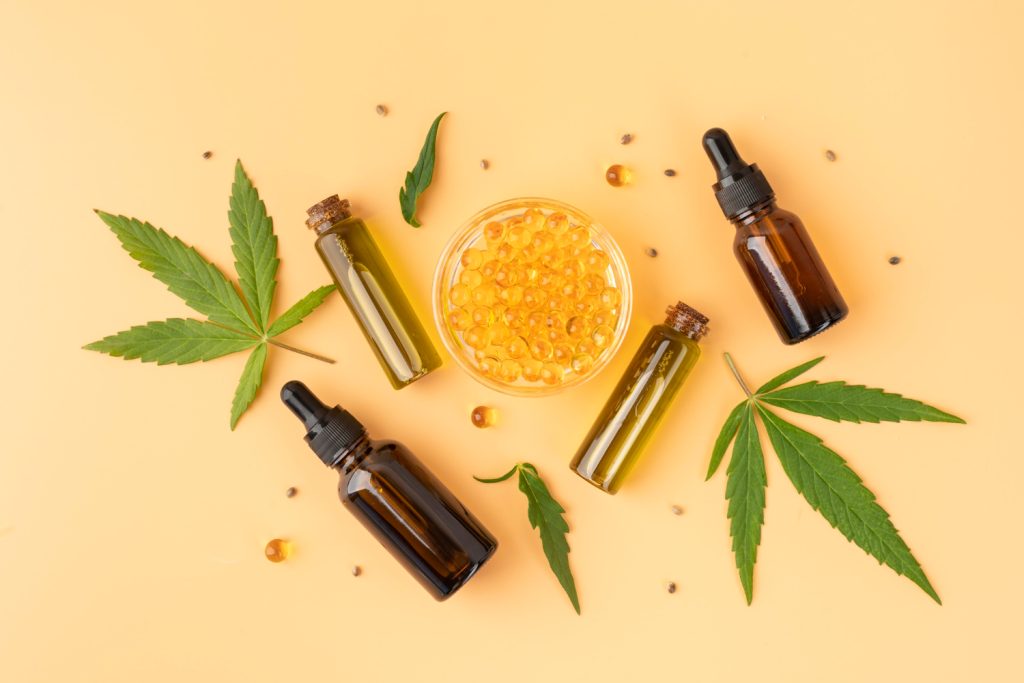
CBD capsules vs CBD oil — which format suits your routine
Cannabidiol (CBD) is available in two common oral formats: oil taken sublingually or swallowed, and capsules swallowed whole. The cannabidiol in both is identical — same compound, same hemp source, same extraction process. The difference is entirely in delivery: how the CBD reaches the bloodstream, how quickly, how precisely it can be measured and how it fits into a daily routine.
This article covers the practical differences between capsules and oil across five factors: onset time, bioavailability, dose precision, convenience and cost. EU Labs does not currently produce capsules — the range covers oil formats only. This comparison is format-level, applicable to any brand’s capsule and oil products using the same underlying extract.
Onset time
Onset time differs between capsules and oil because of how each format delivers cannabidiol to the bloodstream.
CBD oil taken sublingually — held under the tongue for 30 to 60 seconds before swallowing — absorbs through the mucous membrane beneath the tongue directly into the bloodstream, bypassing the digestive system on the first pass. Onset via this route typically ranges from 15 to 20 minutes. The onset time guide covers the sublingual mechanism in detail.
CBD oil swallowed directly (without holding under the tongue) follows the same oral pathway as a capsule: stomach, small intestine, absorption through the intestinal wall, then the liver’s first-pass metabolism before reaching general circulation. Onset via this oral route ranges from 30 minutes to two hours.
Capsules are always swallowed — there is no sublingual option. Onset therefore always follows the oral pathway: 30 minutes to two hours, depending on stomach contents, meal fat content, individual metabolism and capsule formulation. For people who need to know that a CBD serving is active by a specific time, the sublingual oil method offers more predictable timing than any swallowed format.
Bioavailability
Bioavailability is the proportion of an administered substance that reaches general circulation. For cannabidiol, the oral bioavailability via the digestive pathway is lower than sublingual delivery because first-pass metabolism in the liver breaks down a portion of the CBD before it reaches the bloodstream. Estimates for oral CBD bioavailability in the research literature typically range from 6–19%, compared to sublingual estimates in the 12–35% range — though these figures vary widely by study design, individual factors and product formulation.
Capsule manufacturers sometimes address this with formulation choices: softgel capsules with lipid-based delivery systems (emulsified or nano-formulated CBD) are designed to improve absorption through the digestive pathway compared to a plain oil-filled hard capsule. Whether these formulation approaches deliver the claimed bioavailability improvement depends on the specific product and supporting data.
CBD oil taken sublingually has a higher bioavailability ceiling than any swallowed format, because part of the dose absorbs before it reaches the stomach. Taking CBD oil with a fatty meal, whether in oil or capsule form, improves oral bioavailability because cannabinoids are fat-soluble and dietary fat assists transport across the intestinal wall. The MCT carrier oil article covers how carrier choice affects this process.
Dose precision
CBD capsules deliver a fixed, pre-measured amount per capsule. If a capsule contains 25 mg, every capsule contains 25 mg. There is no measuring, no counting drops and no risk of inconsistency between servings. For people who want a fixed daily amount without any measurement step, capsules remove that variable entirely.
CBD oil allows variable dosing. A glass dropper delivers approximately 20 drops per millilitre. At 60 mg/mL (EU Labs CBD Oil 3000mg), each drop delivers approximately 3 mg of cannabidiol. A quarter-dropper delivers approximately 15 mg; a half-dropper approximately 30 mg. The dropper guide covers consistent measurement technique.
Oil’s flexibility becomes an advantage when adjusting serving size. If a starting amount of 15 mg needs to be increased to 20 mg, oil allows that adjustment in a single drop increment. A capsule format at 25 mg per capsule offers no intermediate step between 25 mg and 50 mg. For people still establishing what amount works best for their routine, oil’s adjustability is a practical asset.
The concentrations explained article covers the mg/mL maths for calculating per-drop delivery at different product concentrations.
Convenience and routine fit
Capsules are the simpler format for daily routine use. Swallow one or two capsules with water — no measuring, no taste, no technique. Capsules are easy to carry, don’t require refrigeration differently to oil and produce no sublingual aftertaste. For people who dislike the taste of CBD oil (hemp extract has a characteristic earthy, slightly bitter taste), capsules eliminate the flavour entirely.
CBD oil requires more active engagement: fill the dropper, hold under the tongue, time the hold, swallow. The technique isn’t difficult, but it does require attention each time. For people who integrate CBD oil into a morning or evening routine — alongside other supplements — the technique becomes automatic quickly. The CBG oil morning routine and CBN oil evening routine articles cover how cannabinoid oils fit into time-of-day habits.
For travel or on-the-go use, capsules carry more easily than a glass dropper bottle. A 50 mL glass bottle with a rubber-bulb dropper requires care in a bag; a blister pack of capsules does not. This is a minor consideration for most people but relevant for those who take CBD while travelling frequently.
Cost per milligram
CBD oil typically costs less per milligram of cannabidiol than capsules at comparable quality. Capsule manufacturing adds cost — encapsulation equipment, capsule shells, additional production steps. For the same cannabidiol content at the same quality standard, oil is generally the more cost-efficient format.
This comparison only holds when comparing equivalent quality. A cheap capsule with no third-party testing and an oil with batch-specific independent laboratory verification are not comparable on price — the oil provides something the capsule doesn’t. The quality verification framework covers what documentation to require regardless of format, and the pricing guide covers cost-per-mg comparison methodology.
Which format suits which situation
Neither format is objectively better. The right choice depends on what matters in a specific routine.
Choose oil if: Onset time matters and sublingual delivery is relevant; serving size is still being established and flexibility to adjust is needed; cost per milligram is a priority; the routine already involves measuring other supplements.
Choose capsules if: A fixed daily amount has already been established; taste is a deterrent; simplicity and travel convenience outweigh cost efficiency; the oral pathway timing (30 min – 2 hrs) is acceptable.
EU Labs produces CBD, CBG and CBN oils at two concentrations — 3000mg (60 mg/mL) and 12000mg (240 mg/mL) — in both full spectrum and broad spectrum. The full range is available through the Stillroot shop, shipping to Sydney, Melbourne, Brisbane, Perth, Sunshine Coast, Wollongong and all other Australian locations.
Frequently asked questions
Is CBD oil stronger than capsules?
Strength is determined by concentration (mg/mL or mg per capsule), not format. A 60 mg CBD oil and a 60 mg CBD capsule contain the same amount of cannabidiol. The difference is in how that cannabidiol reaches the bloodstream — sublingual oil can achieve faster onset and potentially higher bioavailability than swallowed capsules.
Do CBD capsules work as well as CBD oil?
Both formats deliver cannabidiol — the difference is in onset timing and bioavailability, not whether CBD is delivered. Capsules follow the oral pathway (30 min – 2 hrs onset). Sublingual oil can be faster (15–20 min). For routine daily use where timing is not critical, capsules work well. For faster onset, sublingual oil is the appropriate format.
Can I open a CBD capsule and take the oil sublingually?
Technically yes, but this approach is rarely practical. Most CBD capsules contain oil in a gelatin or vegetable cellulose shell — the oil is the same or similar to what’s in a dropper bottle. Whether the sublingual approach works depends on the specific formulation and volume. If sublingual delivery is the goal, a dedicated CBD oil with a glass dropper is the appropriate product choice.
Why does CBD oil taste different to capsules?
CBD oil held under the tongue delivers the hemp extract directly to the palate — the earthy, slightly bitter flavour of the hemp extract is noticeable. Capsules bypass the palate entirely, so there is no taste. MCT coconut oil carrier reduces the intensity of the hemp flavour compared to hemp seed oil carriers, but some taste is present with any sublingual oil. If taste is a barrier, capsules or mixing oil into food are the practical alternatives.
Which is easier to dose — capsules or oil?
Capsules offer fixed doses — no measuring required. Oil offers variable doses — useful while adjusting, but requires consistent dropper technique. Once a daily amount is established and fixed, capsules are simpler. While still establishing the right amount, oil’s per-drop adjustability is more practical. The beginner’s checklist covers first-time product selection including format choice.
These products have not been evaluated by the TGA. They are not intended to diagnose, treat, cure, or prevent any disease. You must be 18+ to purchase. Please consult a healthcare professional before use.