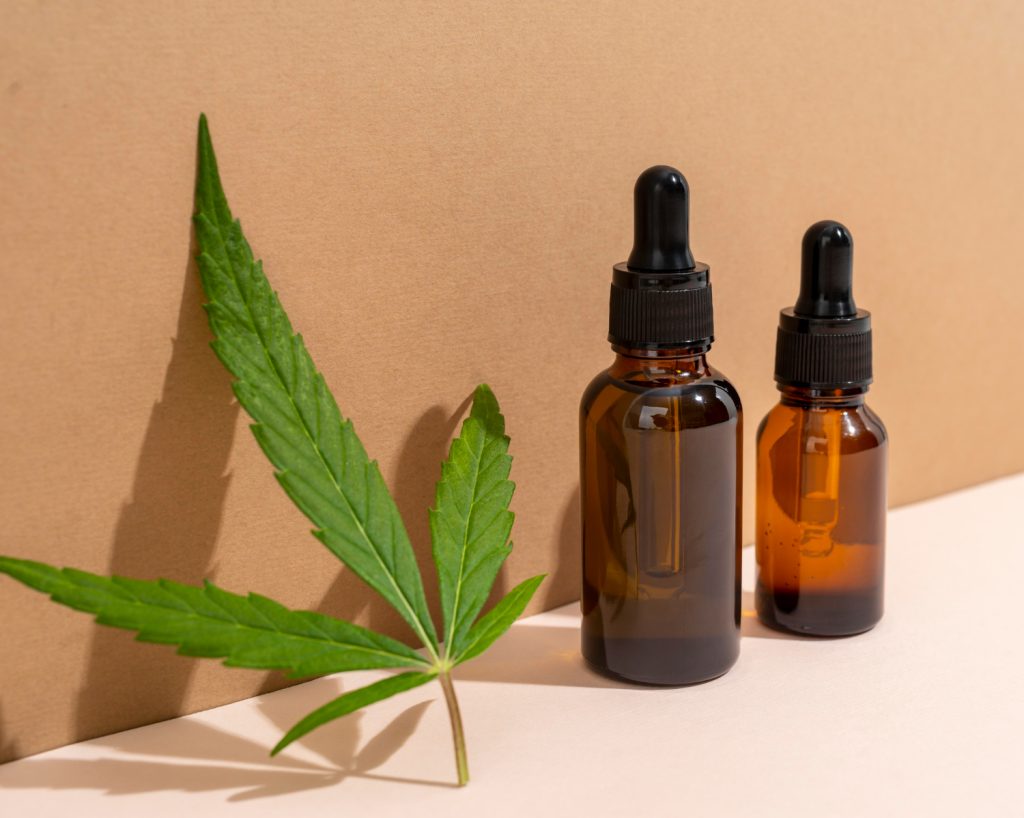
Broad spectrum CBD oil — what zero THC actually means
Three types of cannabidiol (CBD) oil exist, and the difference comes down to what remains in the bottle after processing. Full spectrum retains CBD plus other naturally occurring cannabinoids, terpenes and trace tetrahydrocannabinol (THC) below 0.3%. Isolate strips everything except pure CBD at 99%+ purity. Broad spectrum sits between the two — the full range of hemp-derived cannabinoids and terpenes, with THC removed below detectable limits.
The manufacturing process for broad spectrum and full spectrum CBD oil starts identically. Same hemp. Same CO₂ extraction. Same initial crude output. The difference arrives in a post-extraction step where manufacturers selectively remove THC while keeping cannabigerol (CBG), cannabinol (CBN), CBC, terpenes and flavonoids intact. For a side-by-side of both spectrum types, the full spectrum vs broad spectrum comparison covers that ground in detail.
EU Labs produces broad spectrum CBD oil at two concentrations: the Broad Spectrum 3000mg delivering 60 mg of CBD per millilitre, and the Broad Spectrum 12000mg at 240 mg/mL. Both come in 50 mL glass dropper bottles with medium-chain triglyceride (MCT) coconut oil as the carrier. Third-party lab testing on every batch confirms the cannabinoid profile and non-detectable THC.
For Australians who want CBD oil without THC — whether for workplace drug testing, personal preference or regulatory reasons — broad spectrum is the relevant product category. The practical question is what “zero THC” means on a label and how to verify that claim before buying.
How manufacturers remove THC from CBD oil
Every broad spectrum CBD oil starts as a full spectrum extract. Hemp naturally produces THC alongside CBD and other cannabinoids, so CO₂ extraction — supercritical carbon dioxide pushed through dried hemp material — pulls everything out together. Removing THC while keeping the rest requires a separate, precision step after initial extraction.
The most common method is preparative chromatography. The crude hemp extract passes through a chromatographic column where different compounds separate based on their molecular properties. THC molecules bind to the column material at a different rate than CBD, CBG, CBN and terpenes. The operator collects the fractions containing desired compounds and discards the THC fraction. Done well, chromatography removes THC below 0.01% while preserving the broader cannabinoid and terpene profile.
Short-path distillation offers an alternative approach. The extract is heated under vacuum, and different cannabinoids evaporate at different temperatures. THC can be separated from CBD this way, though distillation is less selective than chromatography and carries a higher risk of degrading heat-sensitive terpenes.
Quality varies significantly between manufacturers. Aggressive or poorly calibrated THC removal strips more than just THC — minor cannabinoids and terpenes disappear alongside it, leaving a product that reads “broad spectrum” on the label but functions closer to an isolate. A certificate of analysis (COA) — a third-party lab report verifying cannabinoid content, potency and contaminant levels — reveals the difference immediately. A genuine broad spectrum COA shows non-detectable THC alongside measurable levels of CBG, CBN, CBC and terpenes. A COA where everything except CBD reads near zero points to over-processing.
What “zero THC” and “THC-free” actually mean
“THC-free” does not mean absolute molecular zero. No analytical method can prove the complete absence of a compound — laboratories can only confirm that THC falls below their detection threshold. When a broad spectrum CBD oil label says “zero THC” or “THC-free,” the claim means THC was not detected at the testing lab’s Limit of Detection.
Two thresholds matter on a certificate of analysis. The Limit of Detection (LOD) is the lowest concentration a lab instrument can distinguish from background noise — the point where the instrument registers “present” versus “not found.” The Limit of Quantification (LOQ) sits higher: the lowest concentration the lab can measure with acceptable precision and repeatability. Between LOD and LOQ, the lab knows a trace amount exists but cannot put a reliable number on it. For those who want the technical detail, a guide to LOD, LOQ and ND on hemp COAs explains how these detection thresholds work across different testing methods.
On EU Labs broad spectrum certificates of analysis, THC appears as “ND” — Not Detected. That means THC concentration falls below the testing lab’s LOD, typically 0.01% or lower. The practical difference between “not detected at 0.01%” and “absolute molecular zero” is scientifically real but functionally irrelevant for any commercial or workplace testing purpose.
Reading the COA properly goes beyond checking the THC line. A complete certificate of analysis for broad spectrum CBD oil shows the full cannabinoid panel: CBD concentration matching the label claim, non-detectable THC, and measurable quantities of minor cannabinoids like CBG and CBN. If a COA only reports CBD and THC without the rest of the panel, the buyer has no way to confirm the product is genuinely broad spectrum rather than a rebranded isolate.
Who chooses broad spectrum — and why
The decision between full spectrum and broad spectrum CBD oil almost always comes down to THC. Both types contain CBD, minor cannabinoids and terpenes. The EU Labs Full Spectrum 12000mg and the EU Labs Broad Spectrum 12000mg deliver the same 240 mg/mL CBD concentration from the same hemp source and CO₂ extraction process. The only variable is whether trace THC remains in the final product.
Workplace drug testing is the most common reason Australians choose broad spectrum CBD oil. Standard urine immunoassays screen for THC metabolites, not CBD. While trace THC in full spectrum products stays well below 0.3%, some people prefer to eliminate even that small variable — particularly those in safety-sensitive industries like mining, transport, healthcare or aviation where a positive result carries serious professional consequences.
Personal preference accounts for much of the rest. Some people simply don’t want any THC in their routine, regardless of the amount. Others choose broad spectrum for regulatory clarity. Under Australia’s Therapeutic Goods Administration (TGA) framework, CBD oil scheduling in Australia classifies products as Schedule 3 (pharmacist-only supply, maximum 150 mg/day) or Schedule 4 (prescription required), and THC content is one factor in that classification.
Neither spectrum type is objectively better. Broad spectrum and full spectrum CBD oil deliver different versions of the same base extract. The choice reflects the buyer’s circumstances — not product quality. EU Labs sells both at two concentration levels — 3000mg and 12000mg — so the spectrum decision stays entirely separate from the dosage decision.
What to check when buying broad spectrum CBD oil
The “broad spectrum” label alone doesn’t guarantee quality. A product can claim broad spectrum status while containing little more than CBD and a carrier oil — technically THC-free, but missing the minor cannabinoids and terpenes that define the category. Five things separate a well-made broad spectrum CBD oil from a poorly processed one.
Full cannabinoid panel on the COA. The certificate of analysis should list individual cannabinoid concentrations — not just CBD and THC. Look for measurable CBG, CBN and CBC levels alongside the non-detectable THC result. EU Labs publishes batch-specific COAs showing the complete cannabinoid panel for every product in the range.
Extraction method. CO₂ extraction produces a cleaner starting material than solvent-based alternatives like butane or ethanol. EU Labs uses supercritical CO₂ extraction across the entire product line, including the Broad Spectrum 3000mg and Broad Spectrum 12000mg. For a technical breakdown, see how CO₂ extraction produces CBD oil.
Carrier oil. MCT coconut oil is the most common carrier for CBD oil because cannabinoids are fat-soluble. EU Labs uses MCT coconut oil in all formulations. Other carriers include hemp seed oil and olive oil — both functional, with different characteristics. The hemp oil vs CBD oil comparison explains that distinction.
Third-party testing with batch traceability. Every EU Labs bottle carries a batch number linking directly to an independent lab report. The lab — not the manufacturer — tests for cannabinoid potency, heavy metals, pesticides, residual solvents and microbial contaminants. Without batch-specific COAs from an independent lab, any “broad spectrum” claim remains unverifiable.
Concentration matching the label. Broad spectrum CBD oil labelled 3000mg should deliver approximately 60 mg of CBD per millilitre in a 50 mL bottle. The COA confirms whether actual cannabinoid content matches the printed claim. Deviations beyond 10–15% suggest quality control issues. Browse the EU Labs CBD range to compare formulations, concentrations and spectrum types. For more on buying CBD oil in Australia, that article covers the purchasing process.
Frequently asked questions
Is broad spectrum CBD oil legal in Australia?
CBD products in Australia fall under Therapeutic Goods Administration (TGA) scheduling. Schedule 3 allows pharmacist-only supply at a maximum daily dose of 150 mg without a prescription. Schedule 4 covers higher doses and requires a doctor’s prescription. Whether a product is broad spectrum or full spectrum is one factor in that classification. For the complete legal framework, see is CBD oil legal in Australia.
Will broad spectrum CBD oil show up on a workplace drug test?
Standard workplace drug tests screen for THC metabolites, not CBD or other cannabinoids. EU Labs broad spectrum CBD oil contains non-detectable THC — below the lab’s Limit of Detection, typically 0.01% or lower. At these concentrations, THC metabolites are not expected to appear on a standard urine immunoassay. Workplace testing policies vary between employers and industries, so consult your employer or a healthcare professional with specific concerns.
What is the difference between broad spectrum CBD oil and CBD isolate?
Broad spectrum CBD oil retains multiple cannabinoids — CBD, CBG, CBN, CBC — plus terpenes and flavonoids from the hemp extract. Only THC is removed. CBD isolate is pure cannabidiol at 99%+ purity with all other compounds stripped away. Broad spectrum preserves a multi-compound profile; isolate delivers a single molecule. For a comparison of individual cannabinoids, see CBD, CBG and CBN differences.
Does removing THC reduce the quality of CBD oil?
THC removal does not inherently reduce quality, but the method and precision matter. Well-calibrated chromatography removes THC selectively while preserving CBG, CBN, terpenes and other compounds in the extract. Poorly executed removal strips multiple compounds alongside THC, producing a product that’s broad spectrum in name only. The certificate of analysis reveals the difference — check the full cannabinoid panel, not just the THC reading.
How do I read a certificate of analysis for broad spectrum CBD oil?
A certificate of analysis from a third-party lab lists cannabinoid concentrations individually — CBD, THC, CBG, CBN and others — alongside contaminant screenings for heavy metals, pesticides, residual solvents and microbial impurities. For broad spectrum CBD oil, the THC line should read “ND” (Not Detected) or “<LOQ” (below Limit of Quantification). The CBD concentration should match the label claim within 10–15%. Every EU Labs product links its batch number to a publicly accessible COA.
These products have not been evaluated by the TGA. They are not intended to diagnose, treat, cure, or prevent any disease. You must be 18+ to purchase. Please consult a healthcare professional before use.